Blindness
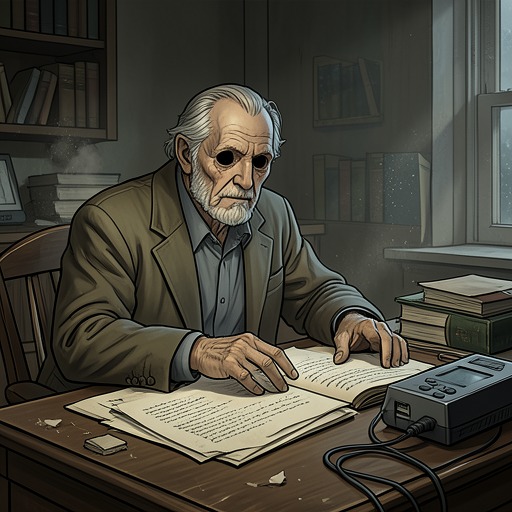
House of LeavesBlindness is both a concrete condition shaping Zampanò’s daily existence and the governing irony of his intellectual work. Although he writes obsessively about seeing, he has been unable to see since the mid-fifties, making his sustained attention to light, film, photography, and visual composition a form of knowledge pursued from physical absence rather than ordinary sight.
Physical Condition and Material Evidence
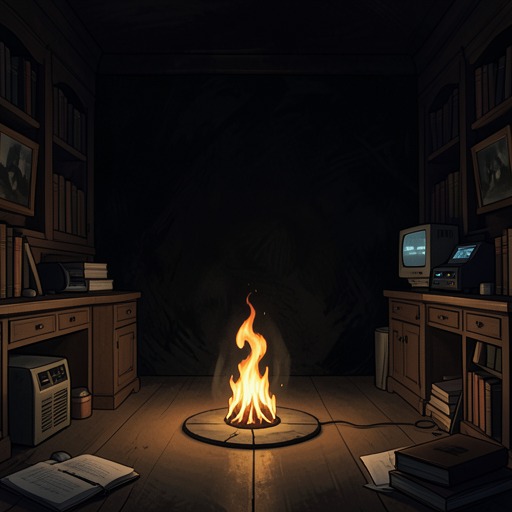
The condition is established through the rooms and objects of Zampanò’s apartment. Its unused candles, complete absence of clocks, strange pale books, and near-total lack of light bulbs—including one in the refrigerator—become retrospectively legible as signs of a life organized without vision. The apartment is eclectic rather than grotesque, but careful observation reveals how thoroughly blindness has altered its material environment.
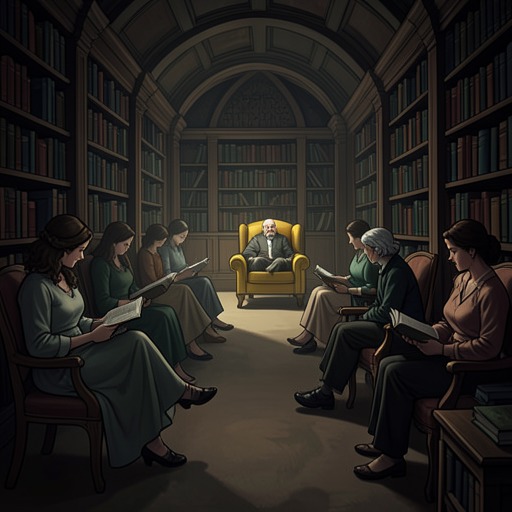
Almost half of Zampanò’s books are in Braille. His access to written language therefore depends on both tactile reading and the assistance of other people: over the years, readers visit him during the day from community centers, the Braille Institute, and USC, UCLA, or Santa Monica College. These arrangements present blindness not merely as an abstract metaphor but as a condition requiring practical adaptations, a network of labor, and recurring dependence on readers whose relationship with him remains partial and difficult to define.
The Paradox of Seeing
Zampanò’s writing repeatedly returns to light, space, shape, line, color, focus, tone, contrast, movement, rhythm, perspective, and composition. Its subject is a documentary film called The Navidson Record, made by Will Navidson, a Pulitzer Prize-winning photojournalist attempting to capture the most difficult subject of all: the sight of darkness itself. The visual vocabulary of the work thus comes from a writer who cannot verify images through ordinary sight, intensifying the contradiction between sensory limitation and aesthetic authority.
The irony is not simply that a blind man writes about vision. Zampanò’s blindness makes the language of visual representation unstable: seeing becomes something described, mediated, reconstructed, and entrusted to others. His work approaches darkness through concepts of light and photographic form while its author lives in an apartment where candles remain unused and illumination is largely unnecessary. The contrast turns blindness into a structural pressure on the text, forcing questions about how perception can be transmitted when direct access to the represented world is unavailable.
Social Perception and Emotional Consequences
Those who read to Zampanò do not agree about what his blindness means. One student considers him certifiably mad, while an actress who spent a summer reading to him thinks of him as a romantic. She remembers finding him deeply depressed rather than drunk: he neither drank nor smoked, lived austerely, cried, and asked her to leave before explaining his condition as heart trouble and old heart-ache matters. The account links his physical blindness to an emotional history whose source remains undisclosed.
Amber describes Zampanò as “imperceivable and alone, though not I think so lonely.” Her formulation distinguishes his opacity from simple isolation. He is difficult to perceive even as others repeatedly enter his apartment to read for him, and his blindness contributes to the unsettling impression that his interior life is present but inaccessible. His condition therefore affects not only what he can see but also how other people imagine, diagnose, pity, or fear him.
Vision, Memory, and the Unseen
Zampanò’s blindness also shapes the uncanny atmosphere surrounding his speech. When Amber asks whether he has children, he says that he no longer has any, then adds that all his readers are his children. His blank eyes and the strange sense that the small apartment has suddenly filled with faces produce in Amber the impression that he can somehow see and address unseen presences. The scene does not establish a supernatural fact; it records how blindness, memory, and inaccessible interiority transform an ordinary conversation into an encounter with ghosts.
The condition consequently occupies an unstable position between bodily fact and narrative device. It is materially demonstrated through Braille, readers, and the altered apartment, yet it also reorganizes the book’s larger concern with perception. Zampanò writes about visual certainty from the position of someone excluded from direct sight, while the people around him must infer his experience through objects, testimony, and expressive fragments. Blindness becomes the condition through which the work examines the limits of evidence: what can be known without being seen, and what remains present precisely because it cannot be directly perceived.